
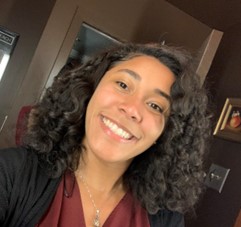
Aliyah K. Shell, Ph.D., is a postdoctoral fellow in the Brian Imaging Research Center of the Psychiatric Research Institute (PRI). She is supported by the NIDA T32 grant under the mentorship of Dr. Maegan Calvert, an Assistant Professor of Psychiatry in PRI’s Department of Psychiatry. Dr. Shell’s primary research goal is to improve the quality of life for those living with neurotrauma and neuropsychiatric disorders by developing targeted rehabilitative interventions that are affordable and accessible to the community.
In her Ph.D. work, Dr. Shell investigated how artificial senses of touch affect the sensorimotor system and evaluated its influence on user experience and functional performance in rehabilitation and virtual reality contexts. She developed a virtual reality based intervention that could be deployed and used for at-home neurorehabilitation. In parallel with her doctoral work, she also worked on a multi-site clinical trial investigating a fully implantable neural enabled prosthesis for upper limb amputees (NCT03432325).
As part of her postdoctoral training, Dr. Shell aims to bridge neurotechnology, translational research, and her personal insight as a family member of individuals affected by substance use disorders. She is committed to creating affordable, accessible, and evidence-based rehabilitative interventions that foster independence, confidence, and resilience.
Dr. Shell received her Bachelor of Science in Biomedical Engineering from Rutgers University in New Jersey. In 2025, Dr. Shell earned her Ph.D. in Biomedical Engineering at the University of Arkansas in Fayetteville, AR. Dr. Shell was awarded a postdoctoral fellowship with the NIDA T32 program at UAMS in 2026, where she is eager to integrate her neurotechnology and clinical research background with the study of interventions for neuropsychiatric conditions and their relationship to substance use disorders.
Publication:
- Shell, A. K., Pena, A. E., Abbas, J. J., & Jung, R. (2022). Novel neurostimulation-based haptic feedback platform for grasp interactions with virtual objects. Frontiers in Virtual Reality, 3, 910379.