• Skip to main content
  • Skip to main content
Choose which site to search.
University of Arkansas for Medical Sciences Logo University of Arkansas for Medical Sciences
Psychiatric Research Institute
  • UAMS Health
  • Jobs
  • Giving
  • About PRI
    • Art of the Psychiatric Research Institute
    • News
    • Leadership
    • Faculty and Staff
    • PRI Careers
    • Video Gallery
  • Substance Use Training
  • Events
  • Learn, Connect, Serve
  • Clinical Care
    • Women’s Mental Health Program
      • Peer Support Specialist Services
      • Reproductive Psychiatry Fellowship
      • Substance Use Treatment
      • Video Gallery
      • WMHP Research
      • Women’s Inpatient Unit – 5 North
      • Women’s Mental Health Clinic
      • Women’s Mental Health Program – Fayetteville Branch
    • Outpatient Care
      • AR ConnectNow
      • Center for Addiction Services and Treatment
        • Improving Access To Treatment For Opioid Use Disorder
        • MATRIARC
          • Project ECHO
        • Medication and Counseling Treatment
        • Medications To Treat Opioid Use Disorders
        • Suboxone Treatment Program
        • Subutex Treatment Program
        • What is Buprenorphine?
        • What Is Methadone?
        • What Is Naltrexone?
        • What Is Vivitrol?
        • Drugs and Addiction
        • New Hybrid Care Program
        • Opioid Use Disorder
      • Child and Adolescent Behavioral Health Center
        • Dialectical Behavior Therapy
        • Family Resources
          • Handouts for Parents
          • Books
          • Videos
        • Meet the Team – Child and Adolescent Behavioral Health Center
        • Questions About the UAMS Child and Adolescent Behavioral Health Center
        • Treatment and Services
      • Psychiatry Clinic in Fayetteville
        • Meet the Team
      • Six Bridges Clinic
      • STRIVE
      • Walker Family Clinic
        • Mental Health Resources
      • Odyssey Clinic
        • Northwest Arkansas Schizophrenia Conference 2025 Media
        • Schizophrenia Conference 2024 Media
      • Neuropsychology
      • Arkansas Employee Assistance Program
    • Inpatient Care
      • Child Diagnostic Unit
        • Child Diagnostic Unit Videos
      • Women’s Inpatient Unit – 5 North
    • Interventional Psychiatry
      • Electroconvulsive Therapy
      • Esketamine
      • Ketamine Infusions
      • SAINT® Neuromodulation System
      • Patient-Visitor Guide To Little Rock
  • Education
  • Research
    • Center for Addiction Research
      • What is Vivitrol?
      • Faculty
        • Alison Oliveto, Ph.D
        • Merideth Addicott, Ph.D.
        • Michael Mancino, M.D.
        • Nihit Kumar, M.D.
    • Center for Health Services Research
      • Behavioral Health QUERI
      • Health Services Research and Development Service
      • Rural Outreach Program
        • Rural Outreach Program Team
      • South Central (VISN 16) Mental Illness Research, Education and Clinical Center
      • Center for Health Services Research Faculty and Staff
        • Alexis S. Childs, Psy.D.
        • Brandon J. Griffin, Ph.D.
        • Christopher Long, Ph.D.
        • Corey Hayes, Pharm.D., Ph.D., MPH
        • Eva Woodward, Ph.D.
        • Jacob Painter, Pharm.D, Ph.D.
        • Leah Tobey, PT, DPT, MBA
        • Marcela Weber, Ph.D.
        • Mary J. Bollinger, MPH, Ph.D.
        • Meghan Breckling, Pharm.D., BCACP
        • Melissa J. Zielinski, Ph.D.
        • Michael Cucciare, Ph.D.
        • Prasad R. Padala, M.D., M.S., FACHE
        • Rajinder “Sonia” Singh, Ph.D.
        • Rebecca Raciborski, Ph.D.
        • Ronald G. Thompson, Jr., Ph.D., LCSW
        • Sara J. Landes, Ph.D.
        • Traci Abraham, Ph.D.
        • Angie Waliski, Ph.D.
        • Geoffrey M. Curran, Ph.D.
        • Greer Sullivan, M.D., M.S.P.H.
        • Jeffrey M. Pyne, M.D.
        • Joy Reeves Pemberton, Ph.D.
        • Karen Drummond, Ph.D.
        • Kristen M. Viverito, Psy.D.
        • Puru Thapa, M.D., M.P.H.
        • Richard R. Owen, M.D.
        • Teresa Hudson, Pharm.D., Ph.D.
      • Postdoctoral Fellowship
        • CeMHOR/HSR&D
        • MIRECC
    • Health and the Legal System (HEALS) Lab
      • Projects in the Health and the Legal System (HEALS) Lab
      • Publications and Media
      • About the HEALS Lab
    • Helen L. Porter and James T. Dyke Brain Imaging Research Center
    • Neurodevelopmental Risk and Resilience Program
    • Research Trials
    • Trauma REsilience & Community Collaboration (TRECC)
      • About TRECC
      • Get Involved
      • Research
        • Current Projects
        • Media
        • Selected Research Publications
      • Resources
        • Measures
        • Tools And Tool Kits
  • Connect
    • Contact Us
    • Mental Health Resources
    • Map and Directions
  • Giving to PRI
  1. University of Arkansas for Medical Sciences
  2. Psychiatric Research Institute
  3. Care in the Balance: PRI’s HEALS Lab Studies Behavioral Health in Legal Settings

Care in the Balance: PRI’s HEALS Lab Studies Behavioral Health in Legal Settings

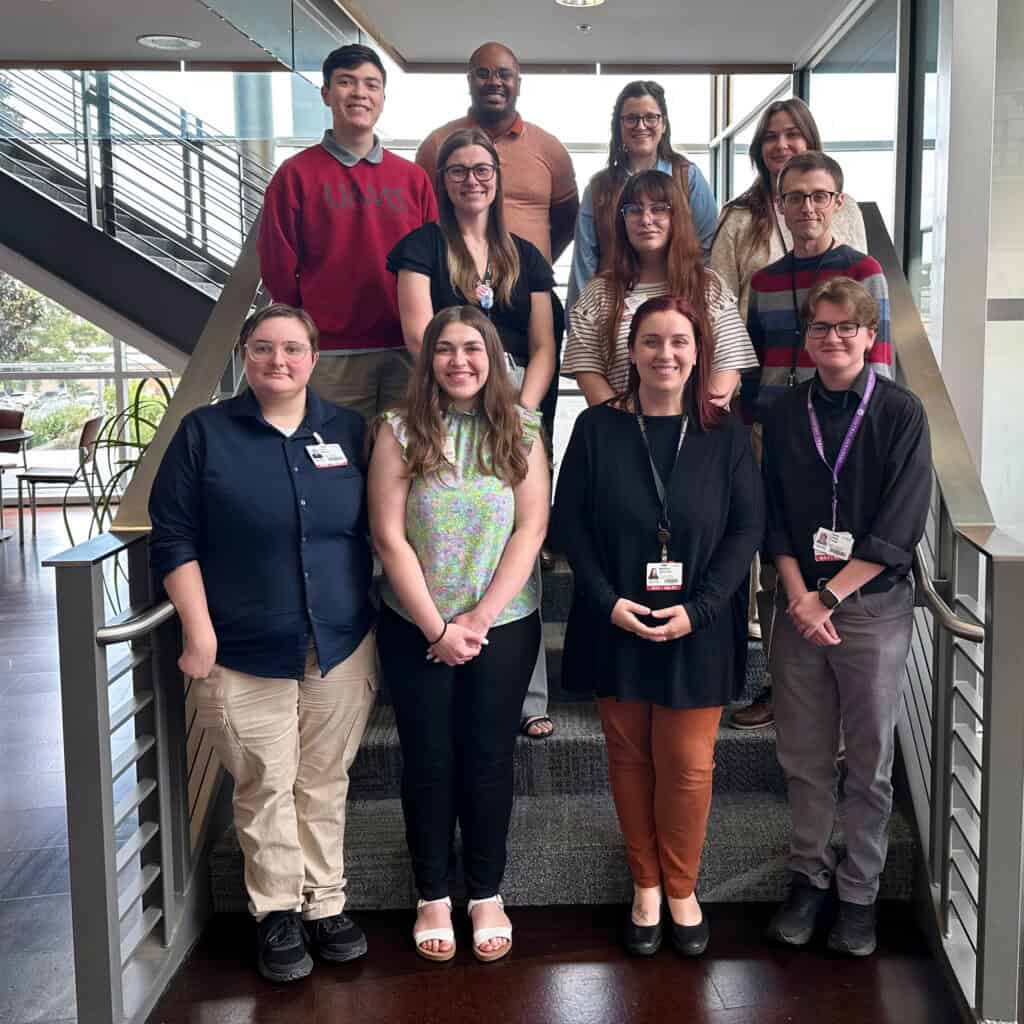
Melissa Zielinski, Ph.D., (front row, second from right) and the HEALS Lab team.

By Kinsey Kranjcec and Nathan Alam

Over the last few decades, behavioral health has become increasingly recognized as a pillar of overall health. That growing attention has brought advances in treatment, efforts to reduce stigma, and greater focus on access to care. Yet, some populations remain overlooked by traditional systems of care. For people involved in the legal system, behavioral health needs can be especially difficult to address as treatment intersects with incarceration, reentry, and other demands of the justice system.

Among people who are incarcerated, post-traumatic stress disorder occurs at rates two to five times higher than in the general population. Left untreated, PTSD can contribute to substance use after release and a greater likelihood of reoffending—which can then exacerbate a cycle of trauma, addiction, and incarceration. Making effective treatment available to this population requires more than knowing what works; it also requires understanding how that care can realistically be delivered within and beyond jails and prisons.

That challenge is at the heart of the HEALS (Health and the Legal System) Lab at UAMS. Led by Melissa J. Zielinski, Ph.D., the lab studies ways to improve behavioral health care for people involved in the legal system. Two of its current projects—STRIDES2, a national study, and HOPE, based in Arkansas—show what that work looks like in practice.

At the national level, STRIDES2 is a National Institute on Drug Abuse (NIDA)-funded study examining Cognitive Processing Therapy (CPT) for incarcerated individuals who struggle with substance use disorder. CPT is a trauma-focused psychotherapy that has consistently been shown to reduce PTSD symptoms and improve related conditions such as depression. The HEALS team is comparing therapist-led group CPT that Dr. Zielinski adapted for criminal justice settings with a standard self-guided CPT workbook, looking at how each approach may affect participants’ substance use, mental health, and experiences after release. They are also evaluating ways to support prison staff as they deliver and sustain CPT within prison and examining the costs of both CPT and the implementation support to help determine what it would take for wider adoption.

Over five years, the study is enrolling 640 participants across 10 correctional facilities in five states. Researchers are following these participants from before treatment through six months after their release, tracking changes in PTSD and depression symptoms, substance use, and their experiences with treatment and criminal justice outcomes. Counselors at participating facilities are receiving CPT training and consultation at no cost with the goal of establishing CPT services that each prison can sustain after the study has ended.

Closer to home, HOPE is a NIDA-funded study in Pulaski County focused on the intersection of opioid use disorder (OUD), stimulant use disorder (StUD), and PTSD. For people with OUD and/or StUD, untreated PTSD is common and can make it harder to engage in substance use treatment and sustain recovery. HOPE is developing new approaches to screening for and treating these conditions in jails and in the community across two key phases. The first phase, which concluded in Fall of 2025, included building a collaborative team consisting of detention center staff, community treatment providers, nonprofit organizations, university medical center partners, and individuals with lived experience of incarceration, PTSD, and OUD. Together, they designed every aspect of a care pathway from how people are screened for OUD, StUD, and PTSD when they enter jail to how they are connected with treatment and ongoing care in the facility and after release. The team also selected evidence-based PTSD therapies that can be delivered both inside correctional facilities and after individuals return to the community in preparation for the second phase.

Phase two, which launched enrollment this March, is a large clinical trial involving 338 people with OUD and/or StUD and PTSD. Participants are randomly assigned to either receive PTSD treatment immediately, while still in jail, or to receive PTSD treatment upon community release. The HEALS team is following participants for 1 year after they enroll in the study to test whether beginning PTSD treatment during incarceration helps people start medication for OUD and continue their recovery after release compared to standard community referrals.

The work being done in the HEALS Lab extends far beyond just these two projects. However, both STRIDES2 and HOPE represent the important research the lab is dedicated to, and their mission to ensure that incarcerated people and people being released from prison are not met with gaps in care and not failed by the systems that have historically left them behind. Indeed, outside of their research studies, the team currently also offers group therapy services in one community correction center and has recently partnered with the state Administrative Office of the Courts to launch a new virtual mental health clinic that will eventually serve participants in Arkansas’ specialty courts statewide. As mental health and substance use remain pressing public health concerns, the lab’s work is helping identify what works, informing policies and programs, and expanding access to effective care for individuals and communities in Arkansas and beyond.

Posted by Tim Taylor on August 18, 2026

Filed Under: Summer 2026

Psychiatric Research Institute LogoPsychiatric Research InstitutePsychiatric Research Institute
Mailing Address: 4224 Shuffield Drive, Little Rock, AR 72205
Phone: (501) 526-8100
  • Facebook
  • X
  • Instagram
  • YouTube
  • LinkedIn
  • Disclaimer
  • Terms of Use
  • Privacy Statement
  • Legal Notices

© 2026 University of Arkansas for Medical Sciences