
• Skip to main content
  • Skip to main content
Choose which site to search.
University of Arkansas for Medical Sciences Logo University of Arkansas for Medical Sciences
Psychiatric Research Institute
  • UAMS Health
  • Jobs
  • Giving
  • About
    • News
    • Leadership
    • Faculty and Staff
    • PRI Careers
    • Video Gallery
  • Events
    • Bridges to Breakthroughs: A Youth Substance Use Summit
    • Learn, Connect, Serve
  • Clinical Care
    • Outpatient Care
      • AR ConnectNow
      • Center for Addiction Services and Treatment
        • Improving Access To Treatment For Opioid Use Disorder
        • MATRIARC
          • Project ECHO
        • Medication and Counseling Treatment
        • Medications To Treat Opioid Use Disorders
        • Optimizing Retention, Duration and Discontinuation Strategies for Opioid Use Disorder Pharmacotherapy (RDD)
        • Suboxone Treatment Program
        • Subutex Treatment Program
        • What is Buprenorphine?
        • What Is Methadone?
        • What Is Naltrexone?
        • What Is Vivitrol?
        • Drugs and Addiction
        • New Hybrid Care Program
        • Opioid Use Disorder
      • Child and Adolescent Behavioral Health Center
        • Dialectical Behavior Therapy
        • Family Resources
          • Handouts for Parents
          • Books
          • Videos
        • Meet the Team – Child and Adolescent Behavioral Health Center
        • Questions About the UAMS Child and Adolescent Behavioral Health Center
        • Treatment and Services
      • Psychiatry Clinic in Fayetteville
        • Meet the Team
      • Six Bridges Clinic
      • STRIVE
      • Walker Family Clinic
        • Mental Health Resources
      • Women’s Mental Health Program
        • Peer Support Specialist Services
        • Reproductive Psychiatry Fellowship
        • Substance Use Treatment
        • Video Gallery
        • WMHP Research
        • Women’s Inpatient Unit – 5 North
        • Women’s Mental Health Clinic
        • Women’s Mental Health Program – Fayetteville Branch
      • Odyssey Clinic
        • Northwest Arkansas Schizophrenia Conference 2025 Media
        • Schizophrenia Conference 2024 Media
      • Neuropsychology
    • Inpatient Care
      • Child Diagnostic Unit
        • Child Diagnostic Unit Videos
      • Women’s Inpatient Unit – 5 North
    • Interventional Psychiatry
      • Electroconvulsive Therapy
      • Esketamine
      • Ketamine Infusions
      • SAINT® Neuromodulation System
      • Patient-Visitor Guide To Little Rock
  • Education
  • Research
    • Center for Addiction Research
      • Optimizing Retention, Duration and Discontinuation Strategies for Opioid Use Disorder Pharmacotherapy (RDD)
      • What is Vivitrol?
      • Faculty
        • Alison Oliveto, Ph.D
        • Merideth Addicott, Ph.D.
        • Michael Mancino, M.D.
        • Nihit Kumar, M.D.
    • Center for Health Services Research
      • Behavioral Health QUERI
      • Health Services Research and Development Service
      • Rural Outreach Program
        • Rural Outreach Program Team
      • South Central (VISN 16) Mental Illness Research, Education and Clinical Center
      • Center for Health Services Research Faculty and Staff
        • Alexis S. Childs, Psy.D.
        • Brandon J. Griffin, Ph.D.
        • Christopher Long, Ph.D.
        • Corey Hayes, Pharm.D., Ph.D., MPH
        • Eva Woodward, Ph.D.
        • Jacob Painter, Pharm.D, Ph.D.
        • Leah Tobey, PT, DPT, MBA
        • Marcela Weber, Ph.D.
        • Mary J. Bollinger, MPH, Ph.D.
        • Meghan Breckling, Pharm.D., BCACP
        • Melissa J. Zielinski, Ph.D.
        • Michael Cucciare, Ph.D.
        • Prasad R. Padala, M.D., M.S., FACHE
        • Rajinder “Sonia” Singh, Ph.D.
        • Rebecca Raciborski, Ph.D.
        • Ronald G. Thompson, Jr., Ph.D., LCSW
        • Sara J. Landes, Ph.D.
        • Traci Abraham, Ph.D.
        • Angie Waliski, Ph.D.
        • Geoffrey M. Curran, Ph.D.
        • Greer Sullivan, M.D., M.S.P.H.
        • Jeffrey M. Pyne, M.D.
        • Joy Reeves Pemberton, Ph.D.
        • Karen Drummond, Ph.D.
        • Kristen M. Viverito, Psy.D.
        • Puru Thapa, M.D., M.P.H.
        • Richard R. Owen, M.D.
        • Teresa Hudson, Pharm.D., Ph.D.
      • Postdoctoral Fellowship
        • CeMHOR/HSR&D
        • MIRECC
    • Health and the Legal System (HEALS) Lab
      • Projects in the Health and the Legal System (HEALS) Lab
      • Publications and Media
      • About the HEALS Lab
    • Helen L. Porter and James T. Dyke Brain Imaging Research Center
    • Neurodevelopmental Risk and Resilience Program
    • Research Trials
    • Trauma REsilience & Community Collaboration (TRECC)
      • About TRECC
      • Get Involved
      • Research
        • Current Projects
        • Media
        • Selected Research Publications
      • Resources
        • Measures
        • Tools And Tool Kits
  • Connect
    • Contact Us
    • Mental Health Resources
    • Map and Directions
  • Giving to PRI
  1. University of Arkansas for Medical Sciences
  2. Psychiatric Research Institute
  3. What Shapes a Developing Brain? PRI Researchers Are Finding Out

What Shapes a Developing Brain? PRI Researchers Are Finding Out

Early childhood is a critical period of human brain development. A landmark new study aims to better understand how the brain develops during this period and how it is affected by exposure to substances and other environmental, social, and biological factors during pregnancy and after birth.

The HEALthy Brain and Child Development (HBCD) Study is the largest long-term study of early brain and child development ever attempted in the United States. More than 5,000 families are taking part in the National Institutes of Health–funded study so far, including over 200 from Arkansas.
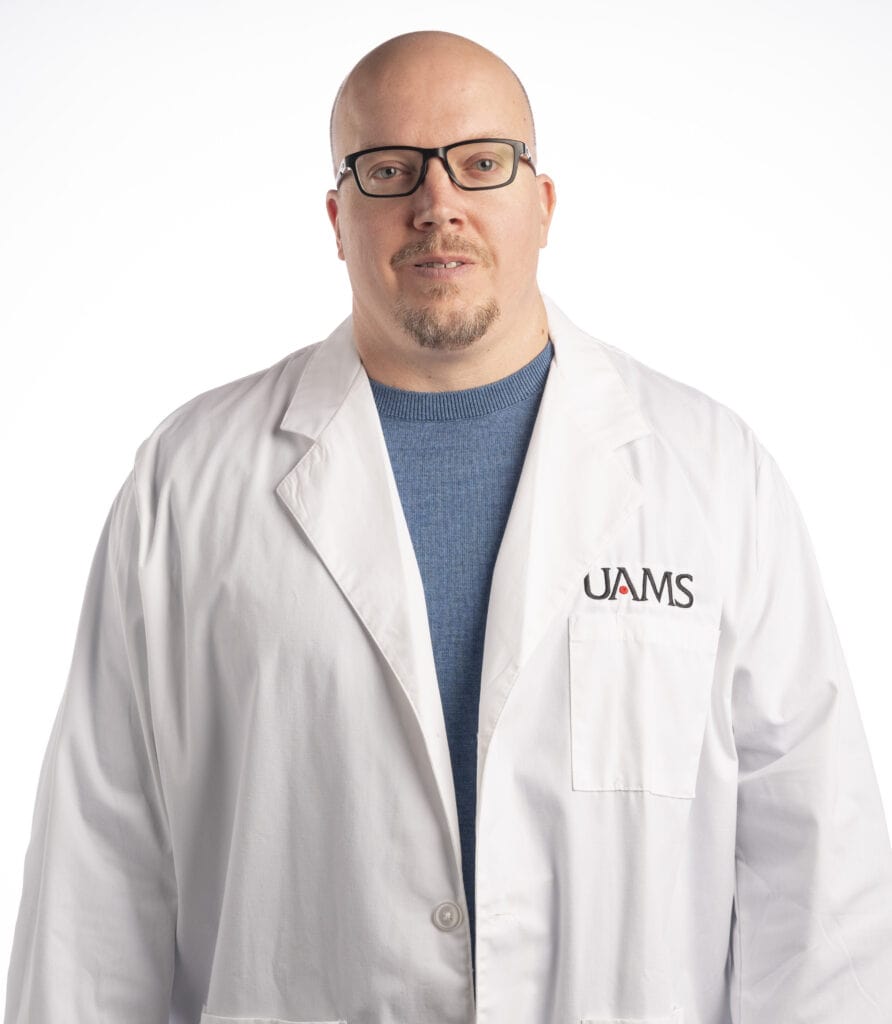
Ashley Acheson, Ph.D.

Ashley Acheson, Ph.D., a professor in the UAMS Department of Psychiatry and the department’s vice chair for research, is leading the Arkansas portion of the study together with professors Xiawei Ou, Ph.D. (Department of Radiology) and Lorraine McKelvey (Department of Family and Preventive Medicine). Acheson and his team have been awarded more than $10 million in funding for participation in the HBCD Study since planning and piloting began in 2019 and are currently overseeing HBCD Study enrollment and data collection in Arkansas, which began in 2023. Acheson and his team are now navigating a vast and growing body of data that could dramatically advance understanding of child development.

“My primary interests in the HBCD Study are to better understand how early-life factors increase risk for addiction and other psychopathology. We know things like having a family history of alcohol and other substance use disorders and experiencing early-life adversity are major risk factors, but it isn’t clear how these factors impact child development,” said Acheson. “We hope the knowledge we gain can lead to improved prevention and early intervention strategies.”

The study aims to track children from the prenatal period to at least ages 9–10, collecting magnetic resonance imaging (MRI) and electroencephalography (EEG)-based measures of brain development paired with an extensive battery of measures, including in-depth assessments of the social and physical environment, medical and family history, biospecimens, and social, emotional, and cognitive development.

The result, Acheson said, is an unprecedented scientific resource—one that could fundamentally reshape how researchers understand human brain development, including the impacts of early-life influences such as prenatal stress and substance exposure, characteristics of the home environment, and parental engagement and other protective factors.
HBCD logo

PRI is one of 27 research sites involved in the HBCD Study, alongside institutions such as Boston Children’s Hospital, Emory University, Penn State University, Northwestern University, and Oregon Health & Science University. The breadth of these sites is deliberate, with researchers seeking a more complete picture of children from diverse backgrounds across the United States.

In February, the study’s researchers published their second data release. The study data, with identifiable personal details removed, are available free of charge to the scientific community.

This release, known as HBCD Data Release 2.0, covers assessments collected from the prenatal period to 17 months of age and adds about 30 new measures, including assessments of language development and physical activity. It is the largest dataset on early brain development in the world, with health and developmental information collected from pregnancy (3,542 participants) through 15 months of age (672 participants).

Approved researchers can access whole-brain MRI scans, EEG recordings, and preprocessed data tables for both imaging and other study measures.

As excited as he is to see some of the initial results from the study, Acheson is equally enthusiastic about working with people in Arkansas as well as around the country who share his passion for the project. PRI’s Andrew James, Ph.D., and Jessica Coker, M.D., are part of the local effort.

“I’ve really enjoyed working and interacting with people across the country on this study,” Acheson said. “It’s been great to collaborate with leading experts on topics like child development, neuroimaging, and epidemiology from top institutions, as well as senior officials at NIDA and NIH. It’s been an amazing experience to be a part of it.”

Posted by Tim Taylor on May 4, 2026

Filed Under: PRI Progress, Spring 2026

Psychiatric Research Institute LogoPsychiatric Research InstitutePsychiatric Research Institute
Mailing Address: 4224 Shuffield Drive, Little Rock, AR 72205
Phone: (501) 526-8100
  • Facebook
  • X
  • Instagram
  • YouTube
  • LinkedIn
  • Disclaimer
  • Terms of Use
  • Privacy Statement
  • Legal Notices

© 2026 University of Arkansas for Medical Sciences